Within some circles of scholarship, there is an argument made that the Gospel of Mark demonstrates little to no concern about the resurrection. This is perhaps nowhere more clear in Mark, than in his abrupt ending. Surely, if the resurrection was central to his thought, a much more fleshed out narrative would have occurred. It follows, so it is argued, that because Mark contains the earliest gospel writings, it also provides the best evidence of what early Christians really believed. Therefore, it is likely that the belief and emphasis on the physical resurrection of Jesus Christ evolved with the growth of the early Church, rather than being central to its foundation.
Sources, Creeds, and Additions
The above argument has several points of truth, but one blatant fallacy. Beginning with what is true, the vast majority of scholars, no matter their other alignments, place Mark as the earliest gospel that we have. There is significant debate about the possibility of Mark having used an earlier “Q” source for much of his material.
This point is rather insignificant for a Christian, as Luke affirms that there have been many such reports (Luke 1:1-4). Whether or not Luke is referring to more than the canonical gospels should matter little to the Christian who trusts that the Holy Spirit was active in the formation of the Biblical cannon.
In addition, the years separating Mark from Matthew, Luke, and John, are minuscule. To believe that these meticulous writers were exaggerating and inflating their own narratives is found wanting by the weight of evidence against such a proposal.
The final consideration that should be remembered with the resurrection and early Christian beliefs, is certainly the statements made in I Corinthians 15. The letter is dated no later than the 60s. More than that, many scholars of various schools believe that the highly focused text on the resurrection is an early Christian creed which pre-dates Paul’s own conversion. Early Christians, no matter what we determine about Mark, without a doubt, had a focused centrality around the resurrection.
The second point that should be affirmed from the initial statement, is that Mark does in fact have an abrupt ending. It is my firm conviction that Mark 16:9-20, along with John 7:53-8:11, should not be in our Bibles, as they are the two “large” sections that have clearly been added into the manuscript record. Such passages have no right to remain in the Christian Scriptures. Therefore, the above statement is correct in describing the ending of Mark as abrupt. Some believe that part of the early scroll was destroyed, which has resulted in the abruptness of the ending. Although this is not implausible, even from a conservative position (cf. II Kings 22), I find the evidence insufficient for such a conclusion. Therefore, I will consider Mark as we have it, ending at Mark 16:8.
With these considerations in mind, we are ready to explore the core of the initial claim: Does Mark care about the resurrection?
Mark 16 – The Ending
First, let’s consider the ending, and then we’ll go from there. We should note that prior to chapter 16, Mark had already stated that Jesus was crucified (15:24, 25), that He had “breathed His last” (15:37), that Pilate had confirmed with the Roman centurion in charge that Jesus was in fact dead (15:44-45), and that he was laid in a tomb with a stone rolled against it (15:46). Without a doubt, Mark has stated that Jesus died by Roman crucifixion and was buried. Death? Check. Burial? Check. Resurrection? Let’s see.
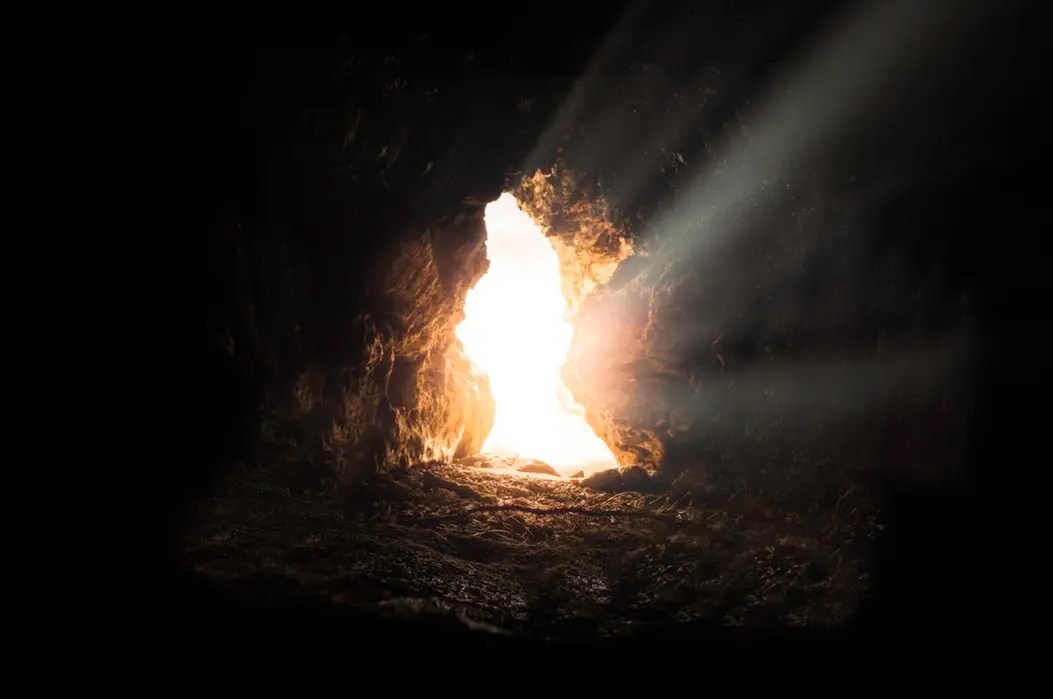
In our shortened and now correct version of Mark, we first see that the stone which had been set in place is now rolled away (16:4). And as we get to the angelic proclamation, perhaps the grand finale of all that Mark has written, we read, “Do not be amazed; you are looking for Jesus the Nazarene, who has been crucified. He has been raised; He is not here; behold, here is the place where they laid Him. But go, tell His disciples and Peter, ‘He is going ahead of you to Galilee; there you will see Him, just as He told you’” (16:6-7, emphasis mine, here and in all to follow). The next, and final, sentence ends with the women’s appropriate astonishment.
So, here we have the final statements by Mark, affirming that Jesus’s body is not in the tomb, that it was the correct tomb (“here is the place where they laid Him”), that they will see Jesus again in Galilee, and, very importantly, that all this would be done according to what Jesus had said to them prior to his death and burial. Before we move on to that point, it is worth noting that with just this proclamation at the end of his narrative, we have sufficient evidence to affirm that Mark certainly cares about the resurrection of Jesus. In particular, that the resurrection of Jesus Christ and his body are intricately, or better yet, inseparably, connected.
But what about Jesus’s earlier references to his own resurrection? Although there are many places where we could draw out Mark’s implications, let’s focus on just three consecutive chapters found in the core of his gospel where we will see some explicit texts.
Mark 8 – Stated Plainly
Immediately following Peter’s confession that Jesus is the Christ (8:29), Mark states that, “He began to teach them that the Son of Man must suffer many things and be rejected by the elders and chief priests and the scribes, and be killed, and after three days rise again. And He was stating the matter plainly” (8:31-32). What is the plain understanding of a person being killed and then three days later rising? Bodily resurrection.
If we have a problem with that idea, we should consider the rebuke Peter receives from Jesus as Peter tries to push back against what Jesus has just said. The words ring clear 2,000 years later, “Get behind Me, Satan!” (8:33). One final note on this section, is to consider Jesus’s use of the word gospel in verse 35. Clearly, Jesus connects His own death, burial, and resurrection to the gospel in complete agreement with Paul (cf. I Corinthians 15:1-19).
Mark 9 – Confusion Despite Clarity
In this chapter, we have another interesting reference to the Son of Man rising from the dead. It is a statement upon which the disciples “seize upon,” as they “discuss what rising from the dead meant” (9:9-10). Once again, we see that the disciples are having quite a difficult time, much like our own unbelieving generation, wrapping their heads around the plain meaning of Jesus’s resurrection.
Just a little later, Jesus declares, “The Son of Man is to be delivered into the hands of men, and they will kill him; and when He has been killed, He will rise three days later” (9:31). And, in typical disciple fashion, “They did not understand this statement, and they were afraid to ask Him” (9:32). By now, we should at least come to realize that despite Jesus’s clear meaning, the disciples themselves were rather ignorant of what he was saying due to their own interests and misconceptions. We should also note that, post-resurrection, we find them all in agreement.
Mark 10 – Exact and Logical Sequence
In Chapter 10, we have another clear statement from Jesus, “Behold, we are going up to Jerusalem, and the Son of Man will be delivered to the chief priests and the scribes; and they will condemn Him to death and will hand Him over to the Gentiles. They will mock Him and spit on Him, and scourge Him and kill Him, and three days later He will rise again” (10:33-34). As the entire description that follows clearly outlines the physical handing over of the Son of Man, the physical condemning of Him, the physical mocking, the physical spitting, the physical scourging, and the physical death, there is no reason whatsoever to believe that anything other than a physical resurrection is assumed. It is only when we bring prior assumptions and forced readings to the text that we can even entertain such unjustified ideas.
Mark and the Resurrection
Even a brief survey of the Gospel of Mark undeniably demonstrates that this early gospel writer thought that Jesus’s resurrection was important. All indications and implications are that this will be a bodily and physical resurrection. Nothing else will do. Bad arguments form for countless reasons. Yet, we can prove beyond a reasonable doubt, that Mark, the earliest writer of a gospel, had a major focus on Jesus’s bodily resurrection. May we not follow the path of the pre-resurrection disciples by setting our own interests in place of God’s. By his grace, may we not fail to understand these plain statements and their implications.
Further Reading
- Redemptive History and New Testament Cannon
- Harry Potter and the Hope of Resurrection
- Jesus’s Divinity and the Septuagint
Photo by Bruno van der Kraan on Unsplash
 Moore Thinking
Leave a comment