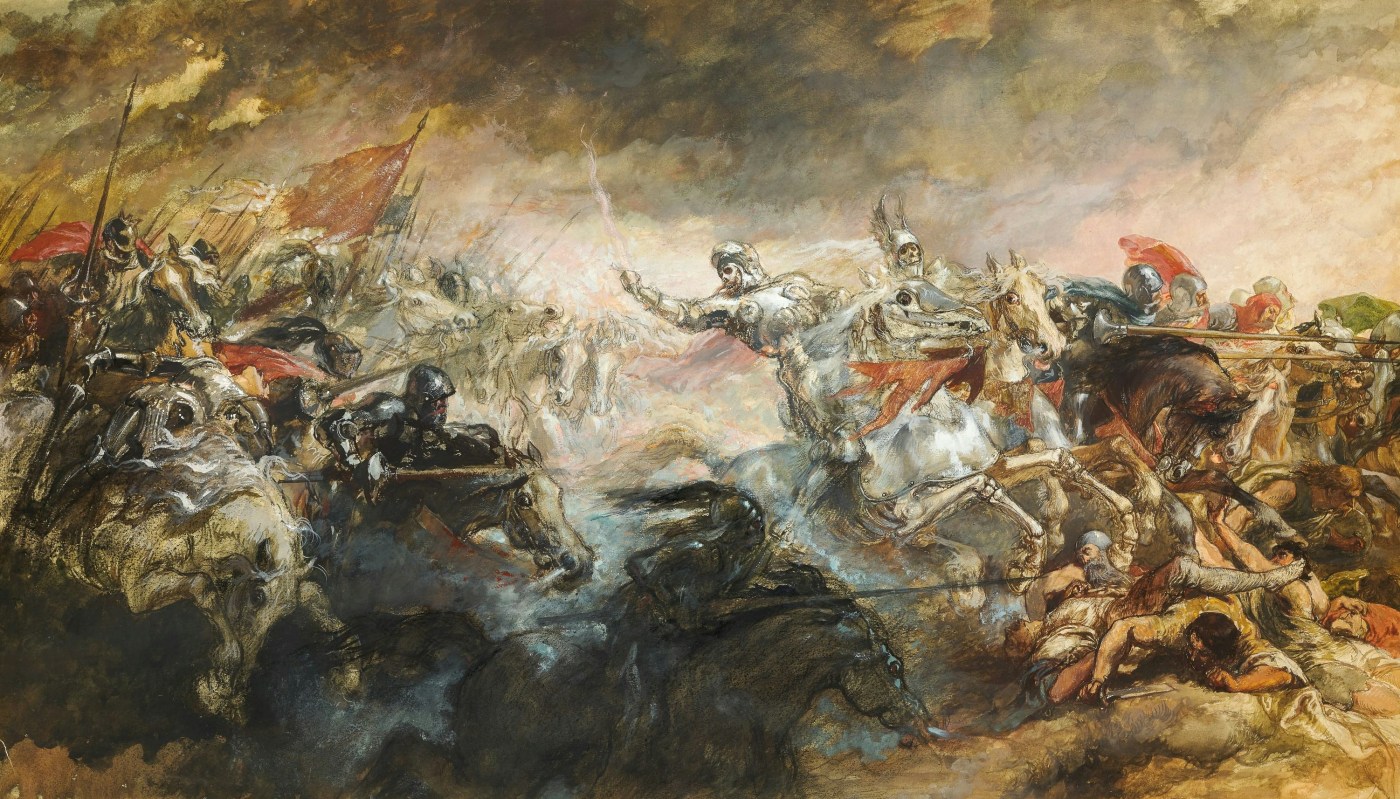
A common sentiment is captured by the question often posed to Christian apologists, which can be summed up as, “What about The Crusades?” Of course, this question need not be taken literally or at surface level. Rather, what lays beneath it is a desire to understand how it can be possible for Christianity to be true in light of the atrocities that have been committed in the past under the supposed banner of Christ.
Our questioner could wonder about The Crusades, colonization, inquisition, the slave trade, or, unfortunately, many other forms of oppression that have been committed in the past by institutions, governments, and people claiming to be followers of Jesus Christ. These are important questions. As followers of Christ, they are worthy of our time, patience, humility, and reflection. We must not assume that those who are wrestling with them are simply looking for an excuse to reject Christ. Nor, can we alter the past in a twisted attempt to shield Christ from the crimes committed in his name. As followers of the Truth, we must zealously commit to speaking honestly about the sins committed by those who have claimed to follow him.
You Need a Standard to be a Hypocrite
That said, one point that is worth making to those who wrestle with this marred history found within Christendom, is to help a questioner to reflect upon the standard that they are using to launch their moral critique. Are they calling Christian slave traders hypocrites? Well, yes, by the terms of what it means to be a Christian, they certainly were. But that’s just the point. Is our questioner aware that they are casting a critique of Christians for not living up to the moral teachings of their own religion?
If we were to remove the standards of Christianity from the table, what will happen to the critique and moral outrage? Shall we replace them with a Darwinian perspective perhaps? Survival of the species and of the fittest doesn’t seem to give us the same moral weaponry for calling out those horrors of the past.
Maybe, we could make an appeal to self-evident human rights? But, what exactly makes us think our modern concept of human rights is self-evident in light of all of human history? Not just Christian atrocities, but the whole lot of violence and hatred that has persisted since the dawn of humanity. Most of these perpetrators surely did not find such actions to be immoral, nor did they think for a second that the truths we hold were self-evident. As historian Tom Holland notes:
Across the western world, this was coming to seem a problem. That every human being possessed an equal dignity was not remotely self evident truth. A Roman would have laughed at it. To campaign against discrimination on the grounds of gender or sexuality, however, was to depend on large numbers of people sharing a common assumption: that everyone possessed an inherent worth. The origins of this principle—as Nietzsche had so contemptuously pointed out—lay not in the French Revolution, nor in the Declaration of Independence, nor in the enlightenment, but in the Bible.1
As Holland notes, not only are these types of values not universal nor self-evident, they are dependent upon history. It is simply not true that secular humanistic values are neutral or have no dependence upon religion. Such a perspective is historically naïve. Once we come to understand this truth, we begin to see how having a moral issue with the crusades, or slavery, or any human rights violation becomes a double-edged sword for those not willing to surrender to the rule of Christ.
Again, as Holland states:
Yet this—despite humanists’ stated ambition to provide ‘an alternative to dogmatic religion’—was nothing if not itself a statement of belief… The humanist assumption that atheism and liberalism go together was just that: an assumption. Without the biblical story that God created humanity in his own image to draw upon, the reverence of humanists for their own species risked seeming mawkish and shallow. What basis—other than mere sentimentality—was there to argue for it? Perhaps, as the humanist manifesto declared, through ‘the application of the methods of science.’ Yet this was barely any less of a myth than Genesis. As in the days of Darwin and Huxley, so in the twenty-first century, the ambition of agnostics to translate values into facts that can be scientifically understood was a fantasy.2
The Moral Foundation
The key point of this article is to demonstrate the important reflection point for needing a legitimate moral standard by which to launch a critique of actions committed by professing Christian people or nations. If one says that such people should have loved their enemies, well, that is what Christ said. If one says that they ought to have freed the captives and set the prisoners free, that is what Christ said. If one says they were abusers of power, corrupted in their morals, and hypocrites, that too is what Christ said of such people.
The fact is that the best foundation for a moral critique of evil actions committed in the name of Christ lay not in a vague notion of humanist sentimentality, but in the active reign of Jesus Christ as King. If Jesus is Lord, then acts committed contrary to his teachings, no matter the claims of men, are acts committed against Him. Without the God of Christianity, and without the modern morals that have been formed by the teachings of Christ, such a critique is lukewarm at best.
In his best-selling book, Sapiens: A Brief History of Humankind, historian Yuval Noah Harari explores the concept of equality and states: “The idea of equality is inextricably intertwined with the idea of creation. If we do not believe in the Christian myths about God, creation and souls, what does it mean that all people are ‘equal’?”3
What Harari (an atheist) is getting at, is the way in which modern values are impossible to justify apart from Christian theology. Sure, we can make an appeal to a collective societal opinion or preference, but that would still be helplessly dependent on Christian influence.
And worse, even that appeal lacks substance. Shall the world really be united through a vision of morality that knows it is not a substantially real and objective thing? ‘Do not murder… because we don’t like when you do,’ just doesn’t have the same ring to it as God’s finger inscribing it on stone, and an entire system of thought grounding such a prohibition on the character of an eternal God who has made humanity in his image. As I wrote in my novel Redeeming Royal, “What man wants to follow a force this strong knowing that it could have come out any number of ways?”4 If morality is nothing more than the product of human evolution, to put it bluntly, who cares? Hence, Holland’s humanistic sentimentality statements.
Of course, we could make that opposing argument more eloquent, but it is important to note that many who are radically opposed to Christian thought admit that modern morality is a deck of cards built upon a Christian foundation. Here is Nietzsche on this topic:
When one gives up Christian belief one thereby deprives oneself of the right to Christian morality. For the latter is absolutely not self-evident: one must make this point clear again and again in spite of English shallowpates. Christianity is a system, a consistently thought out and complete view of things. If one breaks out of it a fundamental idea, the belief in God, one thereby breaks the whole thing to pieces: one has nothing of any consequence left in one’s hands.5
If we want to attack the moral failures of Christians in the past, we need the sword of Christ to do so. Without that, we will merely be whispering our little moral preferences within a chaotic storm of survival and meaninglessness.
A Higher Standard
As we come back to critiques which highlight the hypocrisy of crimes committed in history by those bearing the name Christian, we can and should affirm that this is true. Such a critique (generally considered) provides a true account of some of Christendom’s acts. And, it is a morally correct critique. We ought to be appalled by such actions.
But why do we find such distaste here, and not with the oh so many other atrocities committed within the rest of human history? Well, there are many reasons, but one of which is a fitting end to the thoughts expressed here was said by G.K. Chesterton who wrote, “The Christian is only worse because it is his business to be better.”6
Notes
- Tom Holland, Dominion: How the Christian Revolution Remade the World (New York, NY: Basic Books, 2019), 494
- Ibid. 538; emphasis mine
- Quoted in: Rebecca McLaughlin, Is Christmas Unbelievable? Four Questions Everyone Should Ask About the World’s Most Famous Story (India: The Good Book Company, 2021), 48
- Chandler Moore, Redeeming Royalty: Anthro and the King of Lux, (Nobel Rogue Publishing, 2023), 120
- Quoted in: Timothy Keller, Making Sense of God: An Invitation to the Skeptical (New York, NY: Viking, 2016), 275
- G.K. Chesterton, The Everlasting Man (Daryaganj, New Delhi: General Press, 2019), 114
Further Reading
- Breeding Geldings: The Bottomless Pit of Materialist Morality
- Never Leave Them In Peace – The Apologetics of Blaise Pascal
- Chapter 9: The Reign of the Fittest & Chapter 10: The Moral Doubt in Redeeming Royalty: Anthro and the King of Lux
Photo by Birmingham Museums Trust on Unsplash
 Moore Thinking
A very important post! The following quote was simple, but actually has tremendous depth: “If we want to attack the moral failures of Christians in the past, we need the sword of Christ to do so. Without that, we will merely be whispering our little moral preferences within a chaotic storm of survival and meaninglessness.”
LikeLiked by 1 person